Back
PlatePost: Designing a video-first menu platform for restaurants
Restaurants spend thousands on food photography that lives on Instagram and dies on their website. I designed PlatePost's entire product experience, from the marketing site to the white-label VideoMenus that restaurants use in-store, to make food video the center of the dining decision.
My Role
Product Designer
Timeline
Apr 2024 - Jan 2026
Team
3-person startup, Techstars-backed
The Problem
Here's how most restaurants handle their digital menu: a PDF uploaded to their website in 2019, maybe a Yelp page with photos from random customers, and an Instagram feed that gets updated when someone remembers. The menu a diner sees online looks nothing like the food that actually shows up.
That gap matters. People pick restaurants based on what the food looks like. They scroll TikTok and Instagram for food content, find something that looks good, and then try to figure out where to eat it. But when they land on the restaurant's actual menu, it's a wall of text. No photos, no video, no visual proof that the dish is worth ordering.
PlatePost was built to fix that. The idea: give every restaurant a video-first digital menu that looks as good as the food content people already watch online. Diners scan a QR code or tap a link, and instead of reading a PDF, they see the food in motion.
The team was three people. I was the only designer.
What it led to
5,798 QR scans and +$946 in incremental revenue at Kei Coffee House over 4 weeks. WYWH Coffee reported a 15% sales increase after rollout. 15+ restaurants on the platform by the time I left.
What I designed
Over two years, I owned three interconnected pieces of the product:
The marketing site (platepost.io). This is the first thing restaurant owners see. I designed it to answer one question fast: what does this look like for my restaurant? The site leads with a phone mockup showing the VideoMenu in action, a scrolling partner logo bar (15+ restaurant brands), and a features section that speaks to restaurant operators, not tech people. The CTA is "Book a Demo," not "Sign Up," because restaurant owners want to talk to someone before committing.
White-label restaurant VideoMenus. Each restaurant gets its own branded page. I designed a flexible template system that adapts to different restaurant types: a coffee shop menu looks different from a sushi bar menu, but the core interaction pattern stays the same. Video at the top of each category, menu items with photos and descriptions below, and quick-action buttons for Directions, Call, and Share.
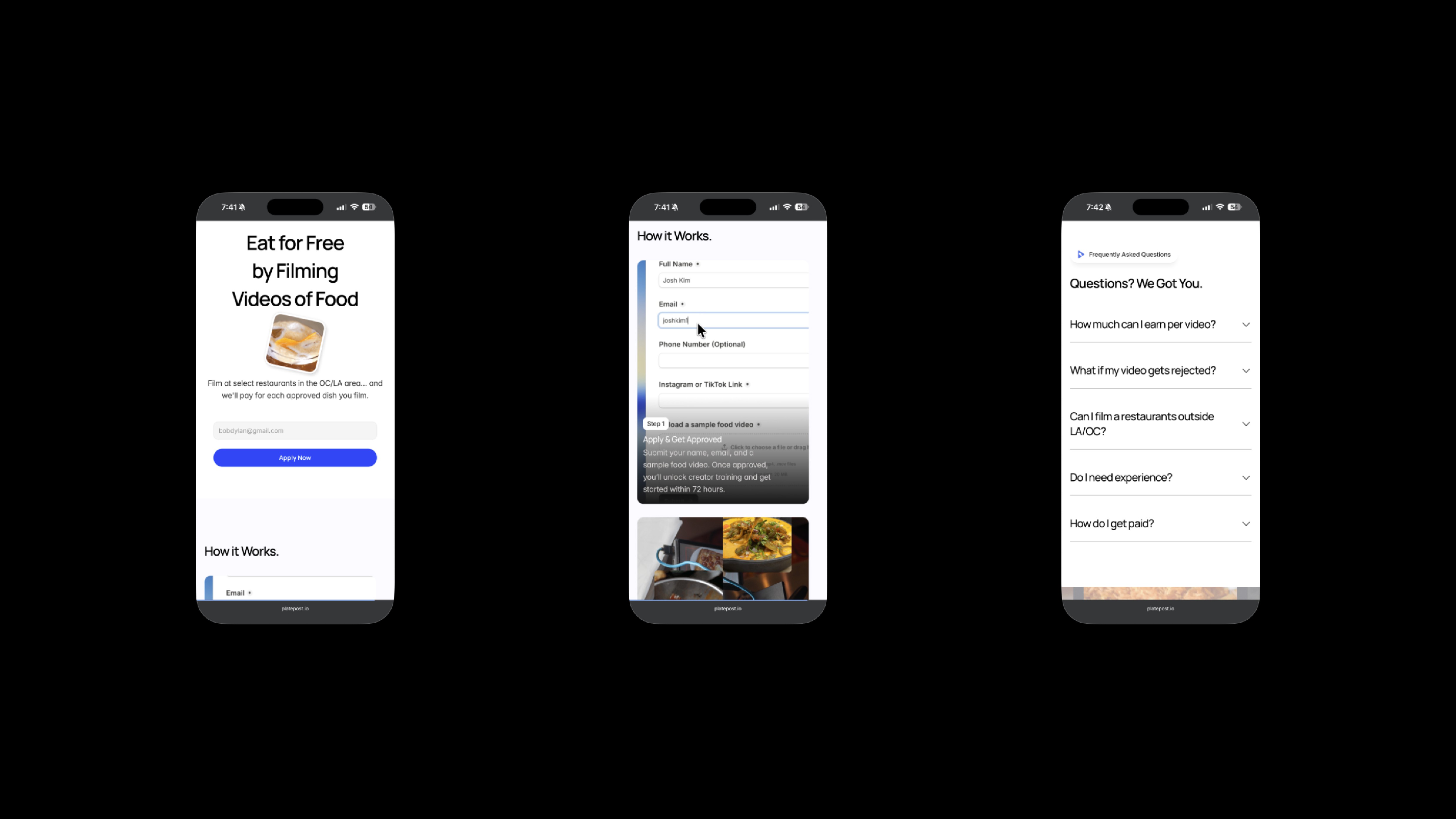
The Creator Program. Restaurants need video content but most can't afford to produce it. I designed a landing page and application flow that recruits food creators to film menu items at partner restaurants. The value exchange is simple: creators eat for free, PlatePost gets content, restaurants get VideoMenus.
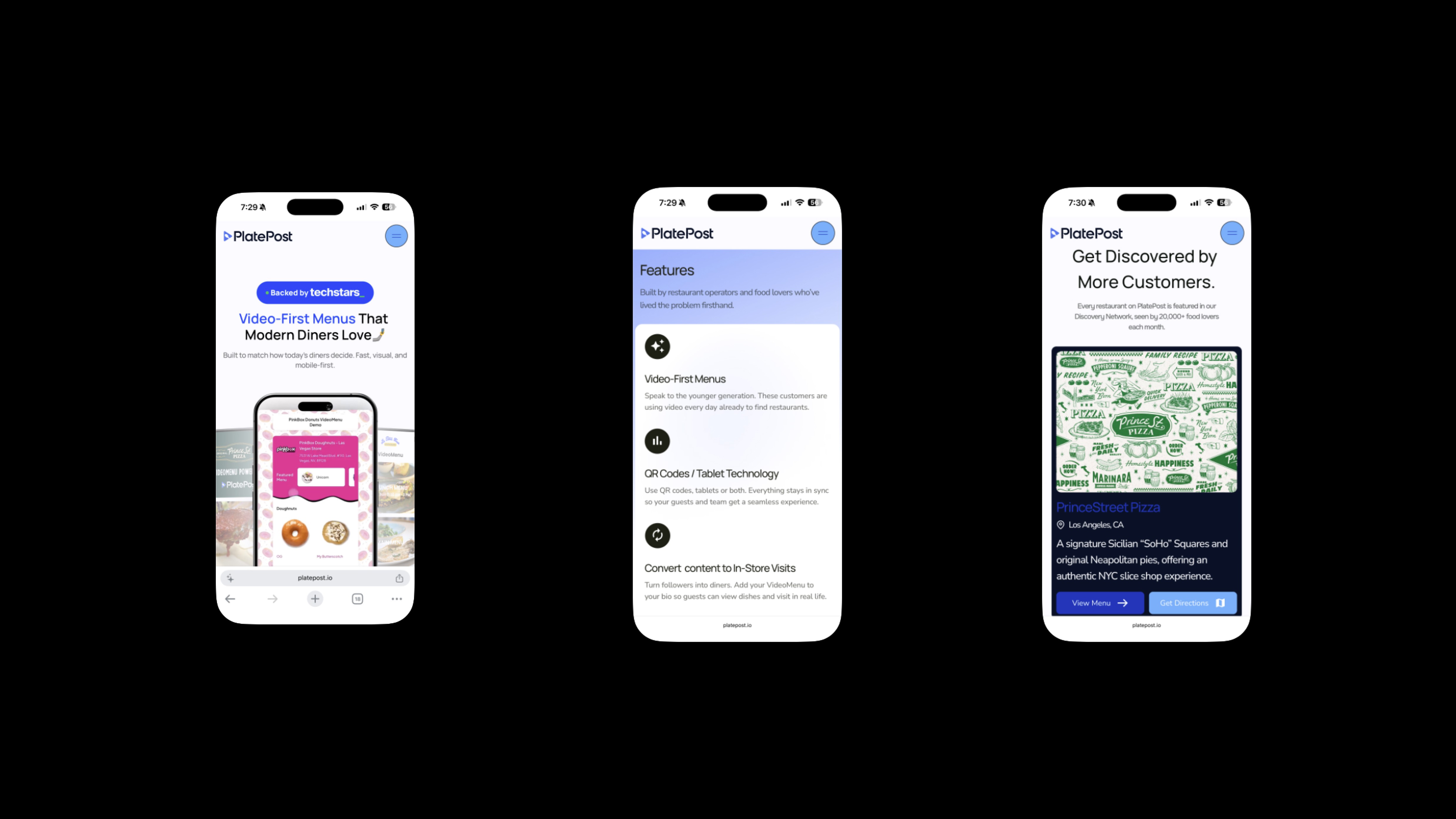
Restaurant VideoMenus
Client work: VideoMenus in production
Every restaurant has different needs. A specialty coffee shop in Orange County needs to highlight seasonal drinks and latte art. A sushi bar in New York needs to show 40+ rolls with clear photos and prices. I designed the template system to handle both.
Here's a sample of live VideoMenus I designed:
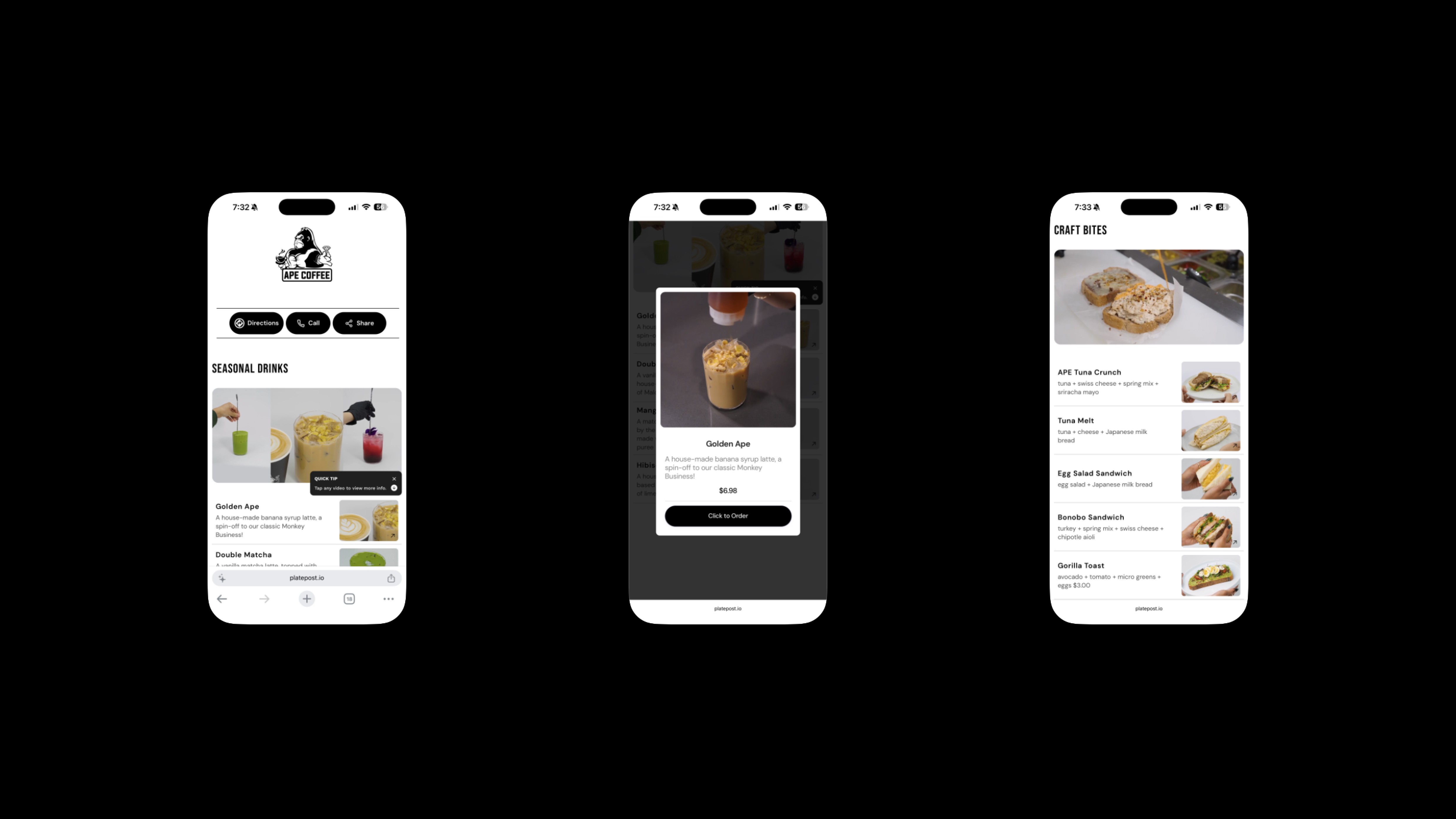
APE Coffee Orange
A bold, high-contrast layout matching APE Coffee's streetwear-influenced brand. Full-width hero with the restaurant name in oversized type, seasonal drinks section with video carousel, and individual menu items with photos. Quick-action bar (Directions, Call, Share) sits right below the hero so customers can act without scrolling.
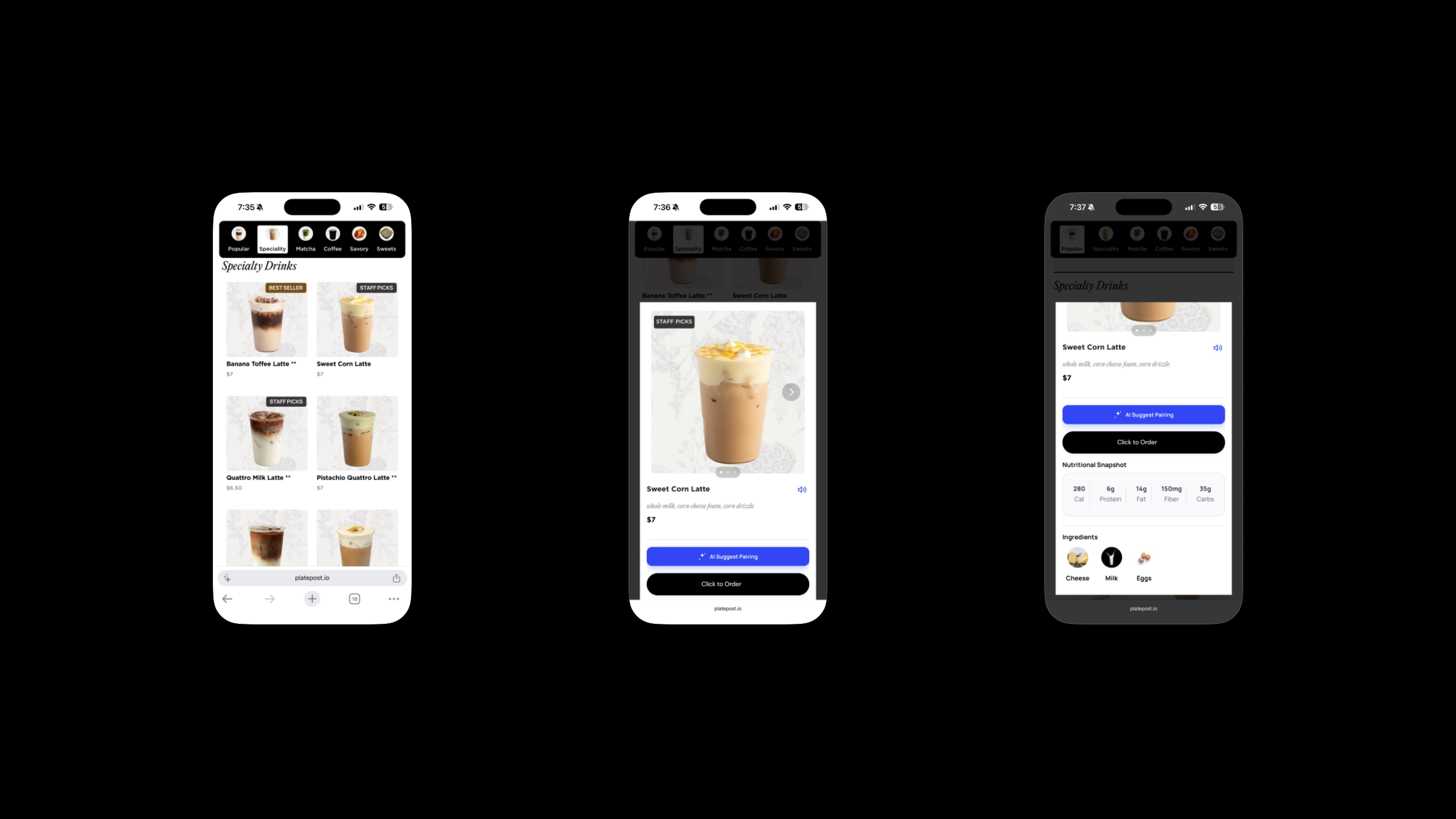
Kei Coffee House (V2)
This was the most iterated menu in the system. Kei Coffee House was our pilot partner, so I designed two versions. V2 has a category navigation bar with icons (Popular, Specialty, Matcha, Coffee, Savory, Sweets) at the top, a hero banner with the restaurant's brand photography, and a "Best Sellers & Staff Favorites" section that highlights top items. Each menu item shows the photo, ingredients, and price. I also added a "Spin to unlock today's rewards" gamification element to drive repeat visits.
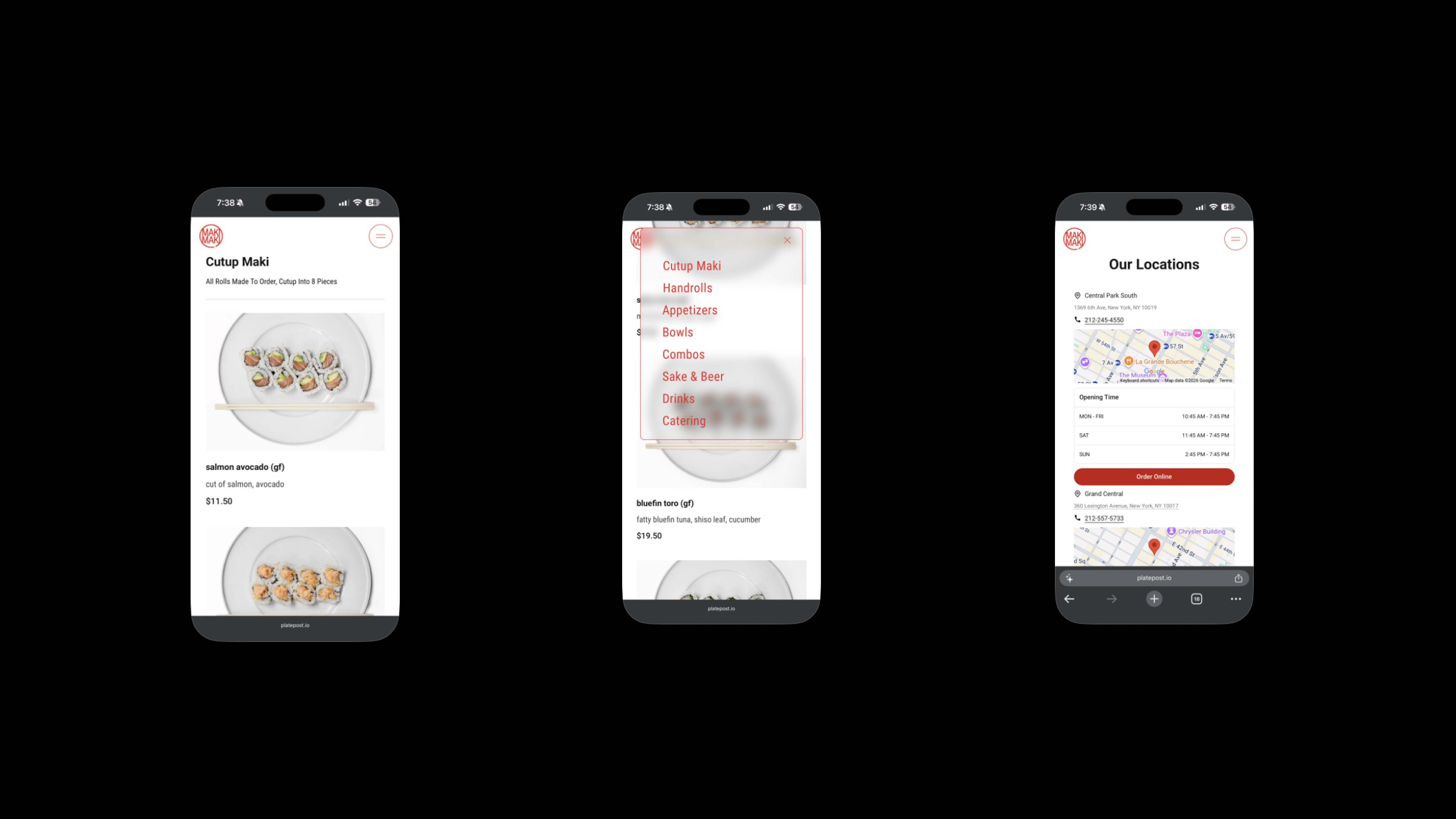
MakiMaki Sushi
A cleaner, more minimal layout for a high-end sushi bar. Grid display with uniform dish photography, organized by category (Cutup Maki, Hand Rolls, etc.). Prices are prominent because sushi pricing varies widely and customers want to see costs upfront. The visual consistency of the plated shots, all on the same white plate from the same angle, was a deliberate art direction decision I made with the content team.
Creator Program
One of the biggest obstacles to getting restaurants on the platform was content. Most restaurants don't have food videos. They barely have good photos. Hiring a videographer for a menu shoot costs $2,000+. That's a dealbreaker for a small restaurant.
I designed the PlatePost Creator Program to solve this. The pitch to creators is straightforward: eat for free at partner restaurants in the LA/OC area, film 5-6 short videos of their best dishes, and get paid per approved clip.
The application flow I designed asks for three things: email, Instagram or TikTok link, and a sample food video. I kept it short on purpose. Every extra form field drops completion rates, and we needed volume. Once approved, creators get access to a training guide and can start booking restaurant visits.
The landing page (platepost.io/home/creator) walks through the process in three steps with visual cards. I used "How it Works" as the anchor section because the concept was new to most creators. Nobody had been paid to film restaurant food before.
The Kei Coffee House pilot
The pilot: Kei Coffee House
Kei Coffee House in Orange County was our first proper pilot. We ran it for 4 weeks (August 25 to September 21, 2025) to test whether the VideoMenu actually changed customer behavior. I was involved in defining the KPIs and setting up the measurement framework alongside the team.
We tracked three things:
QR scan rate. What percentage of customers scanned the QR code to view the VideoMenu? The baseline before PlatePost was 23%. Our target was 25%+. Over 4 weeks, we averaged 21.6% with nearly 5,800 scans across 26,836 total orders. The rate held steady around 22% each week, which told us adoption was consistent even if we hadn't cracked the target yet.
Average order value (AOV). Did seeing the food on video change what people ordered? Baseline AOV was $16.05. During the pilot, we averaged $16.09. Week 1 was the strongest at $16.41, which generated an estimated $2,440 in incremental revenue. Weeks 2 and 3 held above baseline at $16.10 and $16.17. Week 4 dropped to $15.68, but that coincided with back-to-school discounts that drove higher order volume at lower check sizes. After adjusting for the $3,319 in promotional discounts, the adjusted Week 4 AOV was $16.15, still above baseline.
Staff feedback. We sent a survey to front-of-house staff to gauge whether the system added friction or confusion. Results were pending at the end of the pilot period.
The raw numbers: +$946 in incremental revenue across 4 weeks, with an adjusted positive trend once you account for the promotional period. Not a home run, but for a first pilot with a 3-person startup, it was enough signal to keep going.
Week | QR Scans | Total Orders | Scan Rates | AOV | Incremental Revenue |
|---|---|---|---|---|---|
Week 1 (8/25-8/31) | 1,498 | 6,777 | 22.1% | $16.41 | +$2,440 |
Week 2(9/1-9/7) | 1,502 | 6,800 | 22.1 | $16.10 | +$340 |
Week 3 (9/8 - 9/14) | 1,257 | 6,270 | 20.0% | $16.17 | +752 |
Week 4 (9/15 - 9/21) | 1,541 | 6,989 | 22.0% | $15.68 | +2,586* |
Average / Total | 5,789 | 26,836 | 21.6% | $16.09 | +$946 |
*Week 4 drop influenced by back-to-school discounts. Adjusted AOV after adding back $3,319 in promotional discounts: $16.15.
Results
What I shipped over 2 years:
The full platepost.io marketing site, built to convert restaurant owners. A white-label VideoMenu template system powering 15+ live restaurant menus across LA, Orange County, New York, and Las Vegas. The Creator Program landing page and onboarding flow. Two iterations of the Kei Coffee House menu (V1 and V2), including the category icon navigation and rewards gamification. Product UX strategy across the entire platform.
Pilot outcomes (Kei Coffee House, 4 weeks):
5,798 QR code scans. $16.09 average order value against a $16.05 baseline. +$946 in incremental revenue. Consistent 21-22% scan rate across all four weeks.
Business traction:
PlatePost was accepted into Techstars, one of the top startup accelerators. The platform expanded from 1 pilot restaurant to 15+ partner restaurants. The marketing site I designed supported the sales process that closed those partnerships. One client (WYWH Coffee) publicly reported a 15% sales increase after adopting PlatePost's VideoMenu.
Testimonial:
Daniel Betancourt, Owner of WYWH Coffee: "Since incorporating PlatePost's digital menus, we've seen a 15% increase in sales, particularly with our specialty items."
What I learned:
Three people on a team means you design everything. Over two years that was the brand identity, the marketing site, the product, client menus, creator onboarding, sales collateral, and pilot dashboards. No one to hand things off to. I got good at moving fast, making calls with incomplete information, and shipping things good enough to test, then fixing them based on what actually happened.
The Kei Coffee House pilot taught me more than the research phase did. Watching real customers use the QR code, tracking scan rates week over week, seeing whether video menus actually changed what people ordered. Interviews couldn’t give us that.
What I’d do differently
The biggest thing I’d change isn’t a design decision. It’s a product one.
The founder wanted to go website-first. I kept pushing for mobile as the primary product. Websites have real limitations for what we were building, and a restaurant product scales better on mobile. I still think that was right, and I’d push harder for it if I went back.
The other thing is focus. We pivoted a lot. Video menu one week, QR code design the next, then a feedback form, then the creator program. I ended up designing too many things at once, and none of them got the time they deserved. PlatePost needed to pick one thing and go deep on it before adding the next.
Version 2 would be faster, more accessible, and AI-assisted: reservations built in, a loyalty program, maybe a see-what-this-dish-looks-like-in-front-of-you feature like Amazon’s room preview. The product was solid. It just had too many directions pulling on it at the same time.